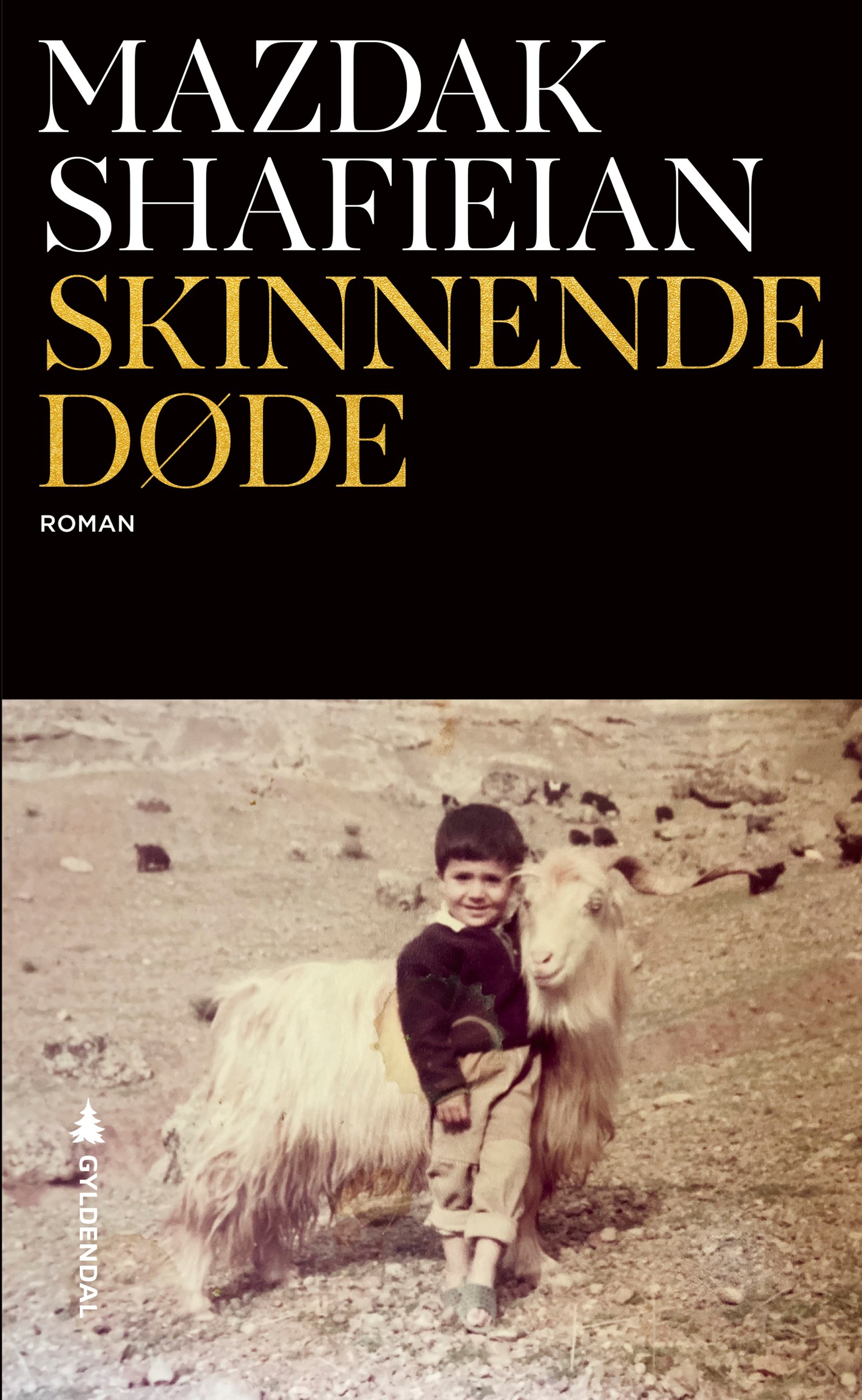
By Mazdak Shafieian
It’s the year 1366 according to the Iranian solar calendar, and 1987 according to the Gregorian, and I am seven years old, as old as the war against Iraq, on the run in a little…
It’s the year 1366 according to the Iranian solar calendar, and 1987 according to the Gregorian, and I am seven years old, as old as the war against Iraq, on the run in a little village with no electricity near Khorramabad.
Shining Dead is based on the author’s own experiences from the eight-year Iran-Iraq war as well as the changes that occurred in Iranian society in the years after the 1979 Islamic Revolution. In perceptive and pictorial language, Shafieian describes a dramatic childhood in which war against Iran’s neighbour is superseded by war against the Iranian people’s own rulers: there are vivid, intricate descriptions of the atmosphere in the cities in the wake of chemical bombardment, alongside accounts of events in left-wing radical circles, with arrests and executions of intellectuals and dissidents as they were experienced by a child. is a novel about memory, about belonging, the home of one’s childhood, and deep love for family and friends.
What emerges is a novel of exceptional quality – on the one hand, an intensely palpable depiction of the Iran-Iraq war between 1980 and 1988, as it unfolded from a child’s perspective, and on the other hand that child’s view of his surroundings, born as he is in the year the war breaks out and thus, at the age of seven, utterly alive to the daily stock of beauty, boredom, colourfulness and deadlock. (...) The child’s sensory awareness of the world around him and the constant pressure of the war accompany each other, set premises for each other, and as such form the emotional imbalance that makes Shining Dead a hugely powerful novel.
Even Teistung, KlassekampenThe first small signs of war and dictatorship are perfectly balanced against more personal and more universal observations, and by local knowledge of the kind that can’t be found in reference books (...) Remembrance and forgetting have been a central concern for Shafieian in both his poetry and his essays. The author, who came to Norway from Iran as a young man, has taken his own experiences as a starting point in Shining Dead. But the language’s workmanship and the free associations of memory work mean that the book fulfils the requirements of the novel genre as well as it does for autobiographical authors such as Sunde, Knausgård, Espedal and Hjorth. In not too many years I reckon it will be natural for us to talk about Shafieian as being alongside the very best.
Frode Johansen Riopelle, MorgenbladetMazdak Shafieian’s novel about a childhood in war-torn Iran is profoundly moving. (...) It’s a convincing debut. On the one hand, Shining Death is a form-conscious examination of memory which moves between the present and the past in elegant sweeps; on the other, it’s a shocking tale of the horrors of war and the reign of terror in Iran after the 1979 Islamic Revolution.
Anne Merethe K. Prinos, AftenpostenAnyone who wonders whether Shining Dead is a detached and fractured account of traumatic experiences will quickly understand that this is not the case – because the novel is gripping.
Praise «’Time heals no wounds’, writes Mazdak Shafieian, ‘it multiplies them’. Time and its workings on life and memory is the pivotal point around which Shafieian’s novel turns: Who is that little boy who grew up in Iran during the Iran-Iraq war? What did he experience, how does it impact him – and how does one find a literary form for the experiences of war? In an unusually beautiful, perceptive prose, Shafieian turns to remembrance with the method of an archeologist; what he digs out, is a novel of outstanding quality. Skinnende døde follows a boy through days as marked by childish boredom as with sudden bomb attacks. The text is equally perceptive of all detail, and as such it paints a world that is horrible and prosaic by turns.”Statement from the jury of theCritics’ Prize 2022
I get the sense of being on the inside of Ayatollah Khomeini’s Islamic Republic. (...) Shafieian writes in a sober language. It is rich in imagery, as tends to be the case when poets debut as novelists. (...) Shining Dead gives a unique sense of gaining privileged access to a society and a time that has gone by.
Knut Hoem, NRKThis is a well-written autobiographical novel that stands out in the Norwegian book world, not only due to its content but also due to its intangibility – something good, bright and compassionate in the text, even when the story being told is dark, hard and painful.
Odd W. Surén, Dag og tidThe little boy’s sensitivity trickles into the reader with the full range of smells, tastes, sights, sounds and sensations (...) I don’t recall having read anything like it since Thomas Bernhard’s childhood memoirs: I hereby add Mazdak Shafieian to my canon of great European writers.
Arild Linneberg, VagantMazdak Shafieian’s novel Shining Death is a unique memoir that looks back on violent years of revolution and war in Iran.
Le Monde diplomatique